Can Airplanes Fly Using Solar Energy? Inside Solar Impulse 2
In July 2016, an aircraft with the wingspan of a Boeing 747 and the mass of a midsize SUV completed a 42,000 km circumnavigation of the planet without burning a single drop of fuel. This is not the story of whether solar flight is possible. It is the engineering story of how it was made possible — and what it cost.
A Deep Technical Review by an Aerospace Engineer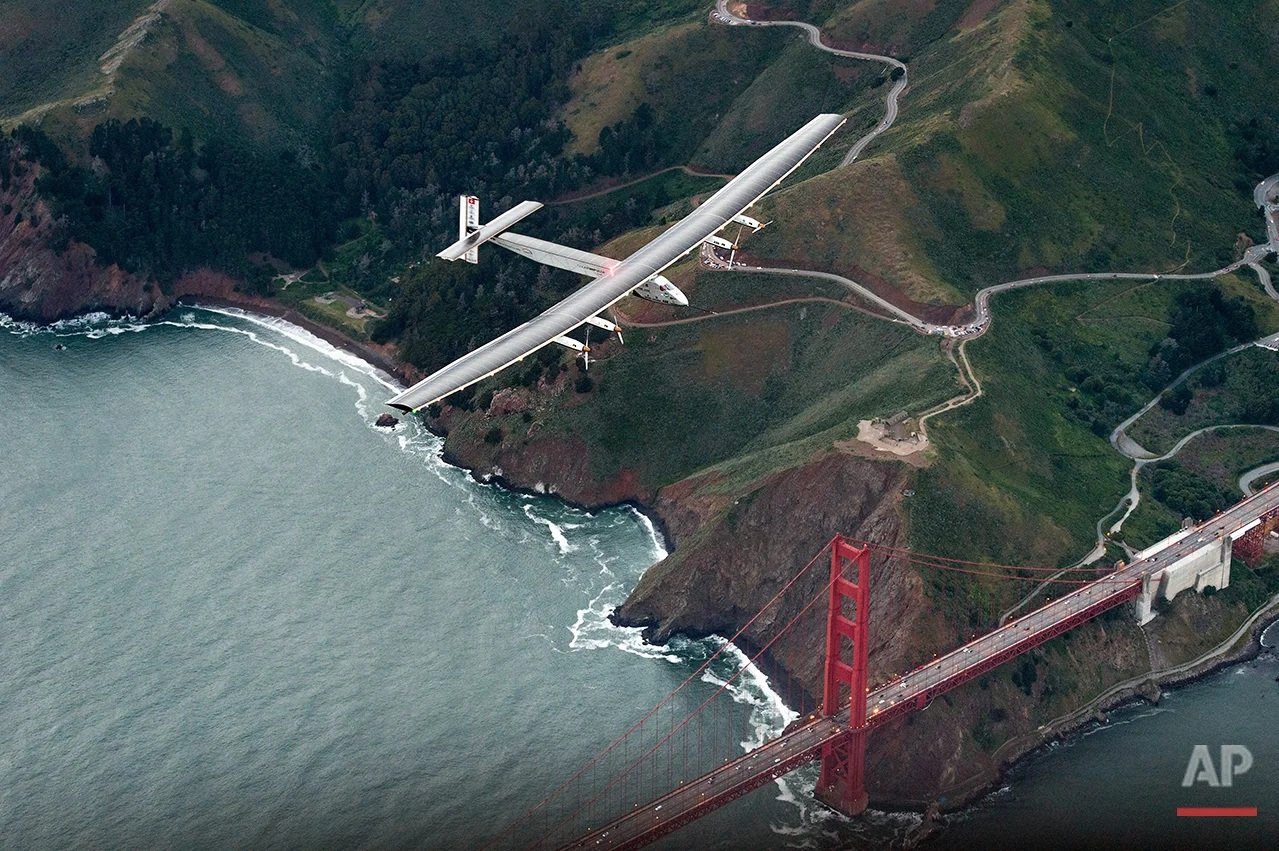
Solar Impulse 2 (HB-SIB) — 71.9 m wingspan, 2,300 kg max takeoff weight, 17,248 photovoltaic cells. Photographed during its 2015–2016 around-the-world mission.
Aviation has always been a fight against weight. Every gram you put on an airplane has to be lifted, accelerated, sustained, and eventually decelerated — and the energy to do all of that has, for over a century, come from burning hydrocarbons. The question of whether an airplane can fly on sunlight alone is, at its core, a question of whether you can close the energy balance: can you collect more energy from the sun, in one daylight cycle, than the aircraft consumes in 24 hours of flight, including the night?
In 2016, Solar Impulse 2 answered that question. Yes — but only at the very edge of what physics and engineering currently allow. As a structural integrity engineer with three decades in commercial and human spaceflight, what fascinates me about this airplane is not that it flew on sunlight. It is that it flew at all, given the constraints its mission imposed on every subsystem. This article looks under the wing skin.
What Solar Impulse 2 Actually Was
Solar Impulse 2 (registration HB-SIB) was a Swiss single-seat experimental solar-electric aircraft, the successor to the proof-of-concept Solar Impulse 1 (HB-SIA). The roughly $170M privately-funded program was led by Bertrand Piccard and André Borschberg, with a development team of 30 engineers, 25 technicians, and over 80 technology partners — Solvay, ABB, Omega, Schindler, Bayer Material Science, and others.
The design problem reduces to a deceptively simple inequality. Over every 24-hour cycle:
Closing that inequality forced extreme choices on every subsystem — structures, aerodynamics, propulsion, energy storage, thermal management, and human factors. None of them sat at a comfortable design margin. All of them sat at the bleeding edge of their respective disciplines.
The Numbers That Define the Airplane
Every downstream design choice on Solar Impulse 2 traces back to these specifications. They are worth examining carefully because they illustrate just how unusual this aircraft is compared to anything else that has ever flown:
The Structural Problem: Lift a 747's Wing With an SUV's Mass
This is where the engineering becomes uncomfortable, and where my own discipline — structures — was pushed the hardest. A 72-meter wing carrying only 2.3 tonnes of total mass gives a wing loading of roughly 8 kg/m². That is an order of magnitude below a regional jet, and lower than many radio-controlled aeromodels. The structure had to be stiff enough to survive flight loads, gusts, and ground handling — yet light enough that the energy balance still closed.
The airframe team solved this with a near-pure carbon-fiber sandwich architecture. Custom prepreg layups produced carbon skins as thin as 25 g/m² — roughly a third the areal density of conventional aerospace carbon plies. The wing was framed by 140 carbon-fiber ribs spaced every 50 cm, with the upper surface forming the photovoltaic substrate and the lower surface a flexible high-strength membrane. The result is a structure that, by any conventional metric, looks under-built. By the only metric that mattered — energy-balance-feasible flight — it was exactly right.
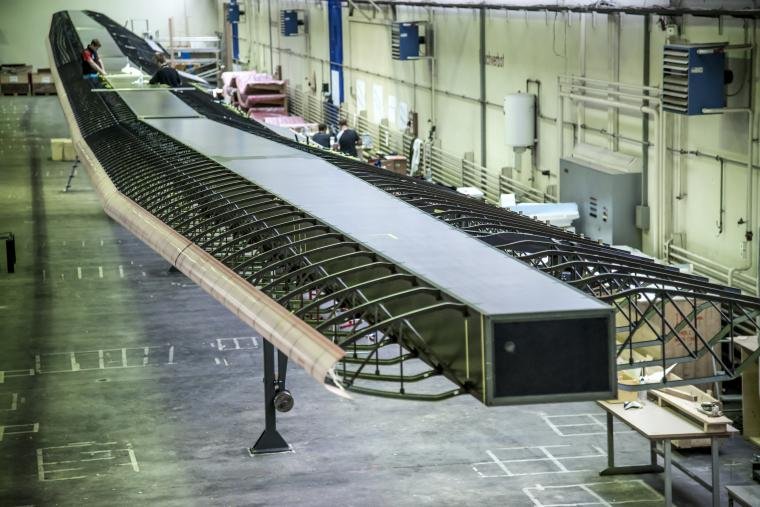
Wing structure during assembly at Dübendorf, Switzerland. 140 carbon-fiber ribs at 50 cm spacing, with 25 g/m² carbon skins — roughly one-third the areal density of conventional aerospace carbon ply.
A high-aspect-ratio wing of this kind introduces a different category of problem entirely: aeroelasticity. Bending and torsional flexibility, combined with very low flight speeds, push the design close to flutter and divergence regimes that a stiffer aircraft would never approach. Small gusts represent a meaningful fraction of cruise velocity. The team mitigated this through stiffness tailoring, careful structural-aerodynamic coupling analysis, and operational envelope restrictions — not through brute structural strength, which the energy budget would never permit.
The Energy Strategy: Flight as a Storage Problem
Photovoltaic generation peaks at solar noon and goes to zero at sunset. Lithium-polymer batteries at 260 Wh/kg are excellent for their era but still represent over a quarter of the aircraft's total mass. The mission strategy bent the flight profile around these realities — turning the atmosphere itself into a second battery.
By day, the aircraft climbed to roughly 8,500 m (28,000 ft) while running the four motors and simultaneously charging the lithium-polymer pack. By night, with no solar input, it descended slowly toward ~1,500 m, trading altitude — gravitational potential energy — for distance, minimizing battery draw. The diurnal climb-and-glide cycle is essentially a gravity battery stacked on top of the chemical battery. A clever use of the atmosphere as a passive energy storage medium.
Over a 24-hour cycle, the average shaft power required is on the order of 6 kW. That is comparable to the power output of the Wright Flyer in 1903. The achievement was not raw performance — it was operating an entire modern aircraft, including avionics, communications, life support, and propulsion, inside that power budget.
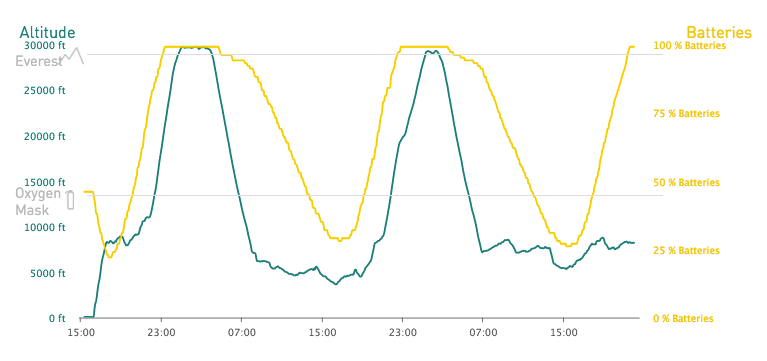
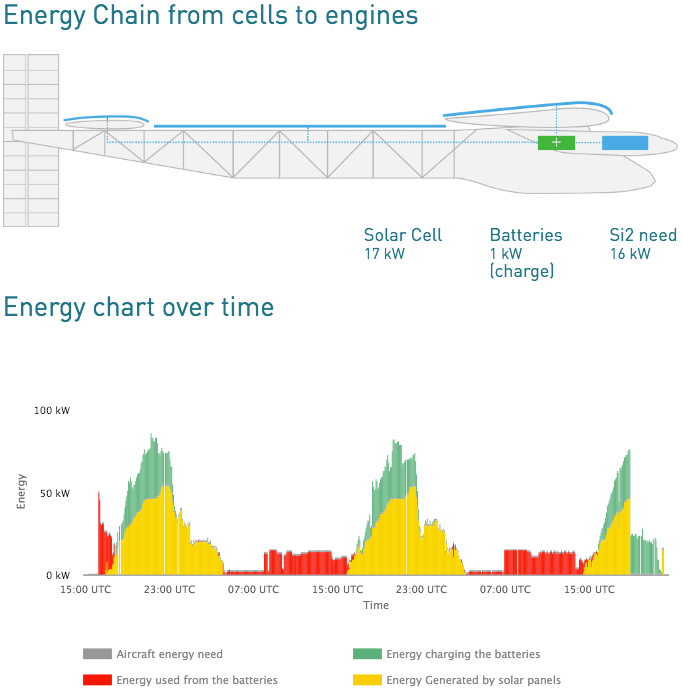
The diurnal climb–glide cycle. By day the aircraft climbs to ~8,500 m on solar power while charging batteries; by night it slowly descends to ~1,500 m, converting gravitational potential energy into distance to conserve battery state of charge.
The Circumnavigation: 17 Legs, 16 Months, 42,000 km
The mission departed Abu Dhabi on March 9, 2015 and returned to Abu Dhabi on July 26, 2016. The route ran east through Oman, India, Myanmar, China, Japan, Hawaii, the continental United States, Spain, Egypt, and back to the UAE — 17 flight legs totaling approximately 42,000 km.
| Leg | From → To | Pilot | Notable |
|---|---|---|---|
| 1 | Abu Dhabi → Muscat | Borschberg | Mission start, March 9, 2015 |
| 2 | Muscat → Ahmedabad | Piccard | First sea crossing — Arabian Sea |
| 5–6 | Chongqing → Nanjing → Nagoya | Piccard | Diverted to Japan; weather hold for one month |
| 8 | Nagoya → Kalaeloa, HI | Borschberg | 117 h 52 min · 8,924 km — world record |
| 9 | Hawaii → San Francisco | Piccard | Resumed April 2016 after 9-month battery rebuild |
| 13 | New York → Seville | Piccard | Atlantic crossing |
| 16–17 | Cairo → Abu Dhabi | Piccard | Circumnavigation complete, July 26, 2016 |
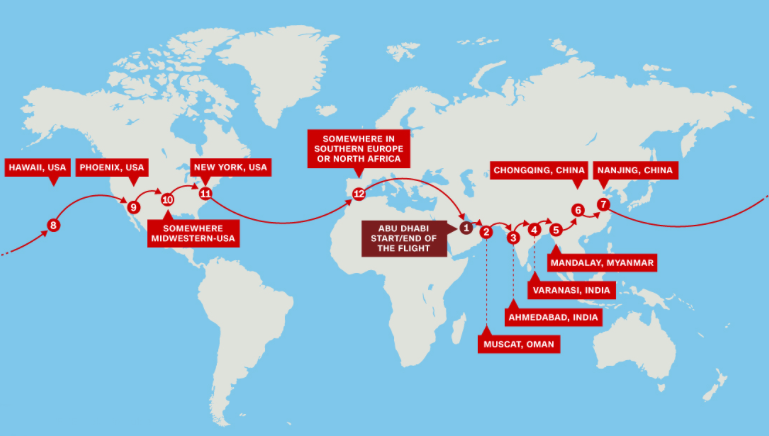
The 2015–2016 around-the-world route. 17 flight legs, 42,000 km, departing and returning to Abu Dhabi. The Nagoya–Hawaii leg (highlighted) is the longest solo flight in aviation history.
The defining leg was Nagoya → Kalaeloa, Hawaii: 8,924 km in 117 hours and 52 minutes, flown solo by André Borschberg. It set world records for longest solar-powered flight by both distance and duration, and the longest solo flight in aviation history. Borschberg flew it on yoga, meditation cycles, and 20-minute polyphasic naps while the autopilot held heading.
It also nearly ended the program.
The Hawaii Incident: A Thermal Management Case Study
During the initial climb out of Nagoya, the lithium-polymer battery pack temperature began rising faster than expected. The root cause, identified post-flight, was deceptively simple and deeply instructive: the battery gondolas had been over-insulated. The insulation had been sized to keep cells warm at the −40°C cruise temperatures the aircraft would encounter at 28,000 ft over the Pacific. What it had not been sized for was the heat generated by sustained high-rate discharge during a rapid climb, with severely restricted heat rejection during that same climb.
There was no in-flight remedy available. Each daily cycle required the climb-descend profile to remain inside the energy balance, so reducing climb rate was not an option. The cells sustained irreversible thermal damage. Although Borschberg completed the leg and landed safely in Kalaeloa, the aircraft was grounded in Hawaii for approximately nine months while a redesigned battery pack and thermal management system were developed, manufactured, and installed.
This is the kind of failure that is invisible until it occurs and obvious immediately afterwards — the signature of a coupled multiphysics design problem analyzed subsystem-by-subsystem rather than as an integrated whole. The Solar Impulse team responded with an engineering discipline that should be emulated: full root-cause analysis, transparent disclosure, complete pack redesign with active cooling, and a published post-mortem. The aircraft flew the rest of the mission without further battery thermal incidents.
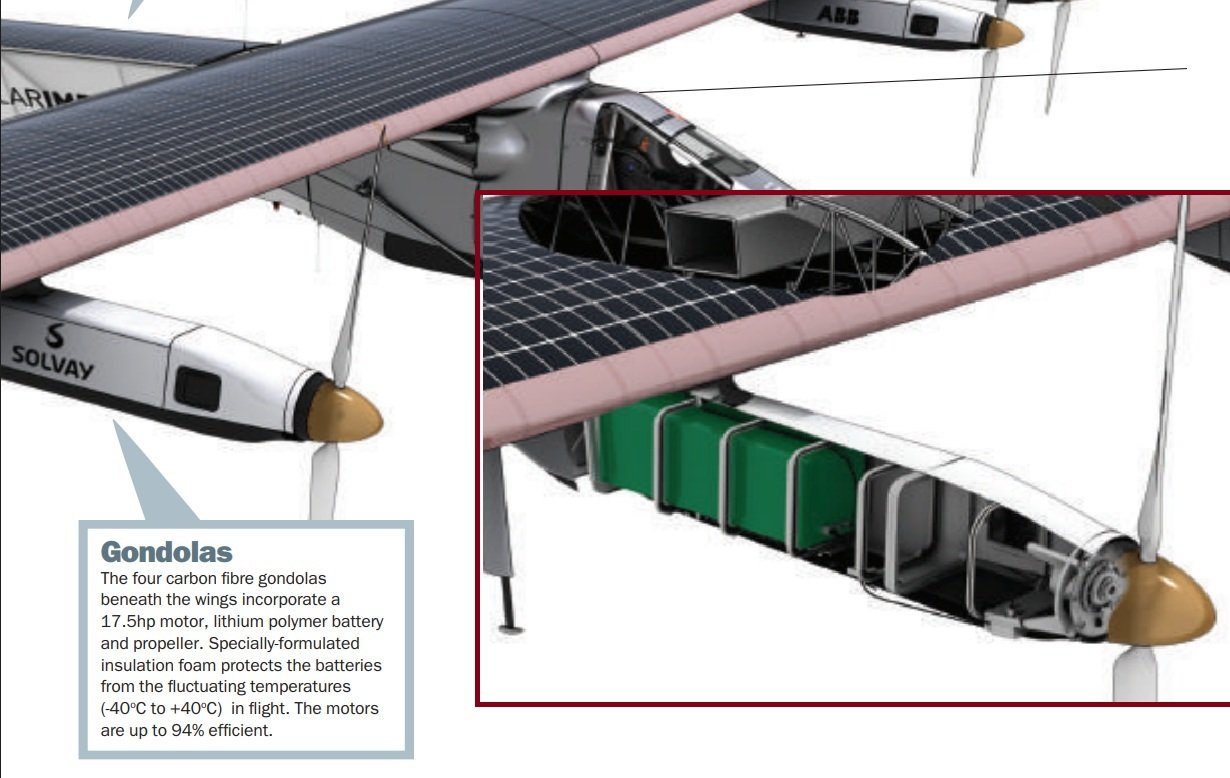
Engine gondola. Each of the four nacelles housed a 13.5 kW BLDC motor and a portion of the 633 kg lithium-polymer battery pack. Over-insulation of these gondolas was the root cause of the irreversible thermal damage during the Pacific crossing.
Engineering Challenges: A Disciplinary Cross-Section
If I had to summarize the disciplines that simultaneously sat at the bleeding edge of their respective design envelopes on this aircraft, the list reads like an aerospace curriculum:
| Discipline | What Was at the Edge |
|---|---|
| Structures | Ultra-low wing loading airframe where aeroelasticity, not strength, drives the design. |
| Aerodynamics | Low Reynolds number cruise with airfoil shape constrained by PV cell substrate requirements. |
| Energy Storage | Battery mass fraction ~27% of MTOW; 260 Wh/kg energy density left zero margin. |
| Thermal Management | Temperature swings from +40°C to −40°C within a single 24-hour cycle, across a high-energy battery pack. |
| Flight Controls | Manual control of a flexible airframe at speeds where gusts represent a meaningful fraction of cruise velocity. |
| Human Factors | 5+ day solo missions in an unpressurized 3.8 m³ cockpit, with oxygen support and short-cycle sleep. |
| Weather Routing | Airframe cannot tolerate convective weather; dispatch criteria are constrained to a degree no commercial operation would accept. |
Where Solar Aviation Has Gone Since
Solar Impulse 2 was an endpoint for one approach — manned, piloted solar circumnavigation — and a starting point for several others. The most active descendants today are unmanned platforms operating in mission classes where endurance and operating cost dominate:
| Platform | Class | Mission |
|---|---|---|
| NASA Helios (legacy) | High-altitude solar flying wing | Atmospheric research. Its 2003 in-flight breakup is required reading for high-aspect-ratio composite structures and gust response. |
| Airbus Zephyr | Stratospheric HAPS | Demonstrated multi-week, then multi-month, unmanned endurance for persistent ISR and communications relay. |
| Skydweller Aero | Autonomous ultra-endurance UAV | Acquired the Solar Impulse 2 airframe technology; developing it into a piloted-optional autonomous platform. |
| BAE PHASA-35 | Solar HAPS, 35 m wingspan | Persistent high-altitude operations for defense and connectivity. |
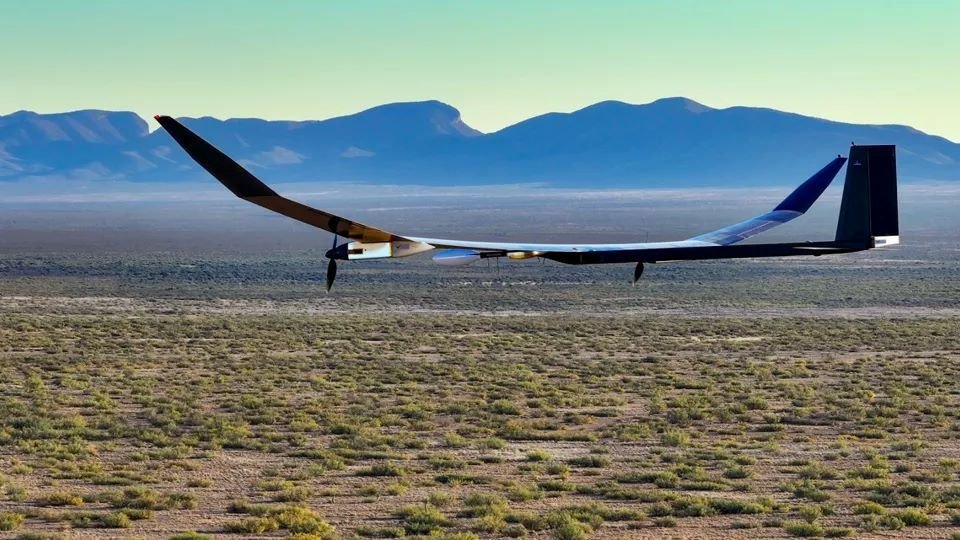
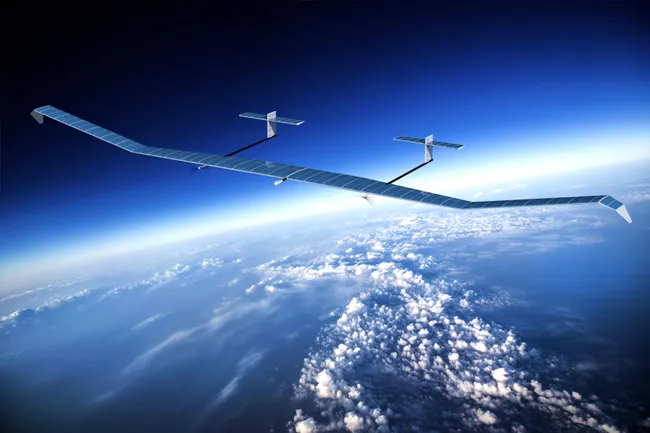
The next generation of solar aviation is unmanned and stratospheric. Platforms like Airbus Zephyr and BAE PHASA-35 build directly on the energy-balance principles that Solar Impulse 2 first demonstrated on a piloted scale.
The Future of Solar-Electric Aviation
Fully solar-powered commercial passenger transport remains physically out of reach for the foreseeable future. The square-cube scaling problem is brutal: as you scale an aircraft up, mass tends to grow faster than wing area, while the available solar flux per kilogram of vehicle falls. Solar aviation will not replace narrowbody jets within any reasonable forecast horizon.
Where it will matter, and is already starting to matter, is in mission classes where endurance and persistent operation dominate, payloads are modest, and the alternative is either a satellite (more expensive) or a fueled aircraft with logistics tail (less persistent):
- High-altitude pseudo-satellites (HAPS): persistent communications, ISR, and Earth observation at a fraction of orbital-asset cost.
- Ultra-endurance unmanned platforms: border monitoring, maritime patrol, wildfire detection, disaster response.
- Environmental and climate monitoring: long-duration atmospheric and oceanographic survey missions.
- Hybrid solar-electric general aviation: supplemental solar to extend range or reduce fuel reserves on light electric aircraft.
The binding constraints remain what they were on Solar Impulse 2: gravimetric energy density of storage, structural scaling, payload-to-energy-budget ratio, and operability in real weather. Every one of these is an active research front. Battery energy density alone has improved from ~260 Wh/kg in 2014 to >400 Wh/kg in current laboratory cells — a 50%+ improvement that would have transformed the Solar Impulse 2 mass budget.
What I Take Away as a Structures Engineer
Beyond the headline achievement, three lessons from this program apply directly to any aerospace development effort I have been involved with:
Postscript: An Airframe That Kept Flying
On May 4, 2026, Solar Impulse 2 was lost over the Gulf of Mexico during an unrelated UAV test program in which it was serving as a research platform. The airframe that flew around the world on sunlight ended its career as a flying laboratory — fitting, in its own way, for an aircraft that was always meant to push the edge of what flight could be.
The lessons it taught us are still flying.
Why This Matters to the Next Generation of Aerospace Engineers
At NovaEd AeroLab, we teach kids that aerospace engineering is not magic — it is a sequence of well-defined trade studies, executed under physical constraints, in service of a mission. Solar Impulse 2 is one of the cleanest case studies of that principle ever flown. Every kilogram of structure, every watt of battery thermal load, every degree of climb angle, every meter of wing flex — all of it was traded against a single energy-balance equation.
That is what real engineering looks like. And that is what we want our students to learn how to do, starting at the level of a balsa wing they build with their own hands.